Persian to Me Was Just a Kind of Cat by Leslie Schultz
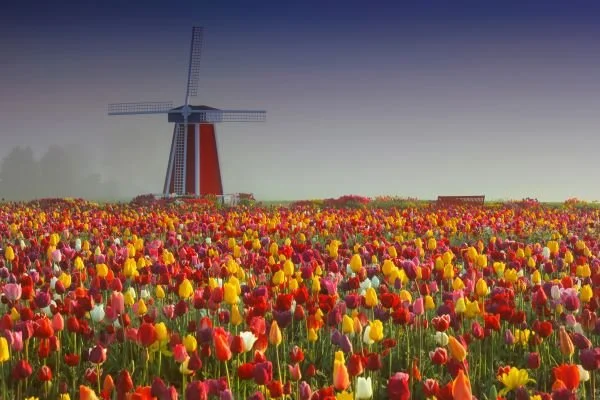
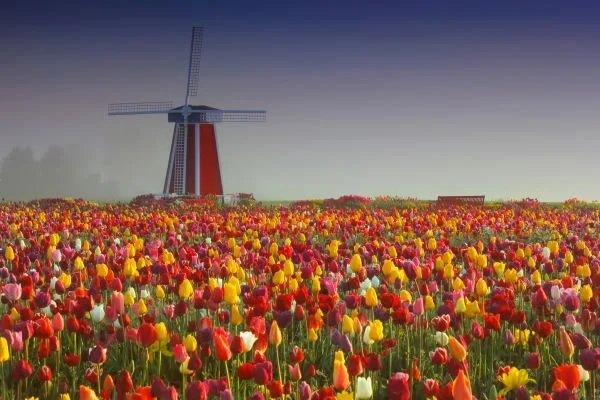
Poetry reader Sarah Bass on today’s poem: As someone from Holland, Michigan, this poem brought me back to the vast technicolor of those spring tulip fields. The conversation Schultz creates or remembers in this poem leans into humor and story, while the beautiful closing language, from “the slow-churning // windmill, white blades like crosses,” to “some were smokey as velvet dresses, / some dark as char” pulls the piece back into something delicate, like a wood mouse nestled in a garden bed. The child speaker isn’t contrarian—rather, they are audacious in the best way. Kids ask big questions and they aren’t afraid to reach for every possibility, and this poem allows its reader to access those memories of all they imagined and to challenge their present assumptions of the limited and the limitless. You can dare to “see tulips / in every color you can imagine, / every color there is.” I worked for several years as a flower farmer, and this poem feels like harvesting a tulip: choose one whose petals are still clasped tight, grasp the stem at a sturdy low point, and pull up the whole plant, bulb and all. The poem, like that tulip, is supple and bright. It shakes off the soil of doubt and beams into the sun.
Persian to me was just a kind of cat
But tulips, I knew, came from Holland,
and grew also next door.
I think I was four. We lived
in Kalamazoo. Grandpa’s big Cadillac
was waiting. We were traveling
to the famous tulip fields in Holland,
Michigan. Grandpa was beaming,
told me, “You will see tulips
in every color you can imagine,
every color there is.” I thought
of my crayons. “Will there be blue?”
Grandpa thought, said slowly, “Well,
maybe not blue.” I thought more.
“Green?” “No,” he sighed, closing the car door.
I sat back, stumped, then kicked my thin legs out,
crowed, “What about black?!” He shook
his head defeated, and drove on
in silence. A long while. I felt bleak,
at a loss. Finally, I marched with him past
soldier rows of stiff blooms, near the slow-churning
windmill, white blades like crosses,
looked into the flowers’ cupped hearts, and saw
some were smokey as velvet dresses,
some dark as char.
Leslie Schultz has six collections of poetry, most recently '“Geranium Lake: Poems on Art and Art-Making” (Kelsay Books, 2024). She is a judge for the annual Maria W. Faust Sonnet Contest. Her poems can be found widely in journals and stamped into the sidewalks of Northfield, Minnesota.
Find her at winonamedia.net